Physical Address
North California Coast
United States
Physical Address
North California Coast
United States

A story of my 3rd Great Grandmother, created with my research using AI
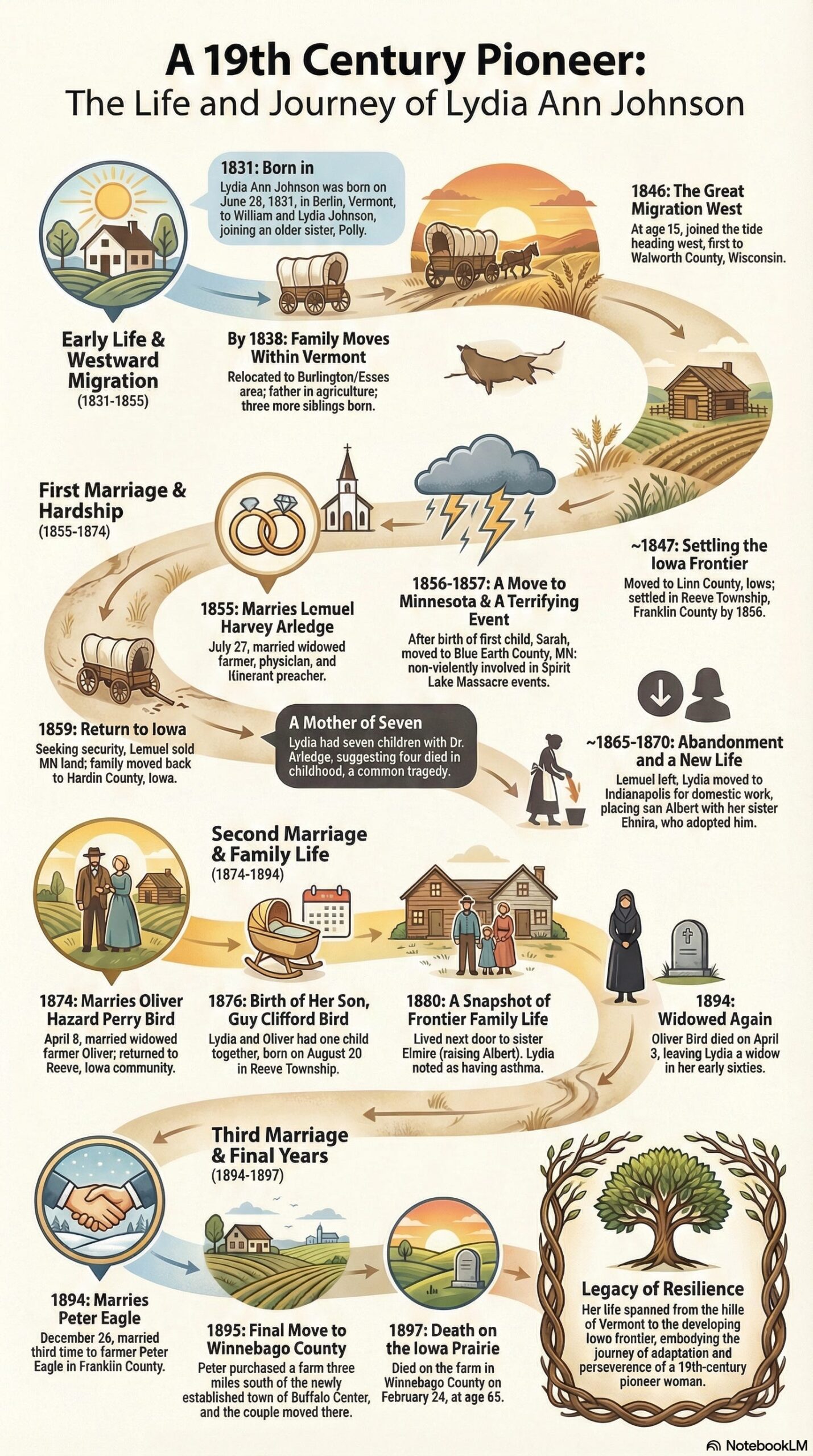
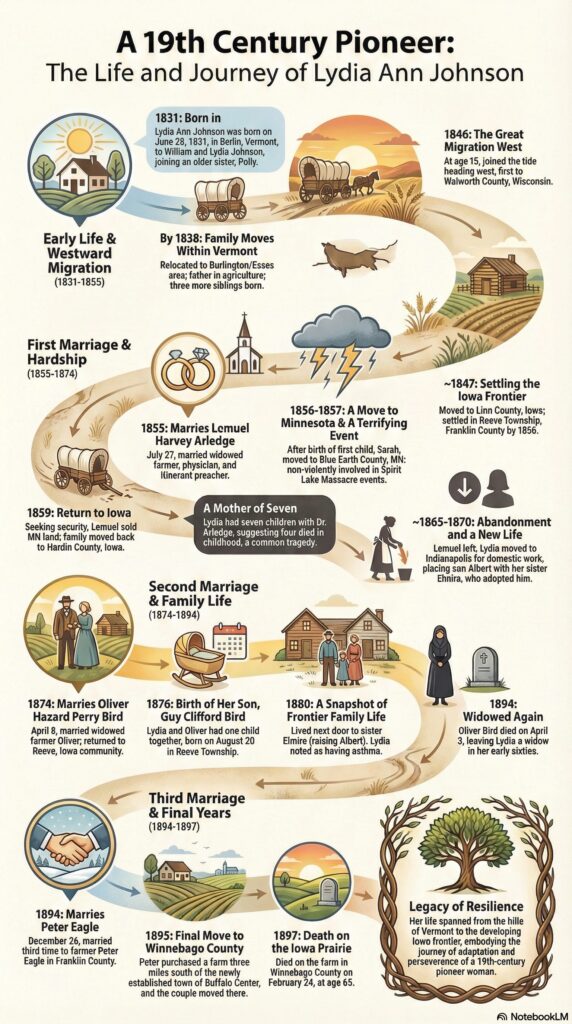
Lydia Ann (Johnson) Arledge Bird Eagle was born 28 June 1831 in Berlin, Washington County, Vermont, and died 24 February 1897 on a farm about three miles south of Buffalo Center in Winnebago County, Iowa. Across nearly seventy years she moved from New England villages to the developing Midwest frontier, raising children, enduring hardship, and adapting repeatedly as a farmer’s daughter, a physician-preacher’s wife, a domestic servant, and finally the wife of an Iowa farmer in the 1890s.
Lydia was the daughter of William B. Johnson, born about 1801 and deceased about 1864, and Lydia H. Stone, born in 1817, who were living in Berlin, Vermont, when she was born on 28 June 1831. She joined an existing household that already included at least one child and was part of a young family still on the move as New Englanders followed opportunity westward.
Her parents expanded their family quickly. An older sister, Polly B. Johnson, had been born about 1830, probably also in Vermont. Before 1838 the Johnsons moved to the Burlington area, and by the time of the 1840 federal census William B. Johnson appears in Essex, Chittenden County, Vermont, working in **agriculture**, reflecting the common pattern of small-scale mixed farming in northern New England at that time.
Lydia grew up with several siblings whose lives intertwined with hers for decades. Her sister Elmira S. Johnson, later the wife of Alexander Creighton, was born about 1838, likely in or near Burlington, Vermont. Another sister, Elonora C. Johnson, was born about 1842, and a younger brother, William B. Johnson, was born about 1845, all after the family’s move toward the Burlington–Essex area.
These siblings remained important to Lydia after the family left Vermont. When Lydia’s marriage to Lemuel Arledge failed and she struggled to support her children, Elmira and her husband Alexander in Iowa took in Lydia’s son Albert and by 1880 had adopted him, a reminder of how extended families shared responsibilities on the nineteenth‑century frontier.
Sometime after her birth and before 1838, Lydia’s parents moved from Berlin to the Burlington region, placing the family in a growing Lake Champlain trade corridor served by river, lake, and overland routes that tied Vermont to both New York and Canada. By 1840 they were enumerated in Essex, Chittenden County, where William farmed, likely raising mixed crops and livestock in the rocky but productive New England countryside.
In 1846, when Lydia was about fifteen, the Johnson family joined the larger tide of New Englanders heading west, moving first into the former Michigan Territory and then into Walworth County, Wisconsin, where they stayed for about a year. Soon afterward they continued on to Linn County, Iowa, which had only been a state since 1846 and where land was relatively affordable for small farmers, often advertised at around a dollar or so per acre for federal land, making ownership accessible to families like the Johnsons.
By about 1856 the family moved again within Iowa to Reeve Township in Franklin County, where William continued farming on the open prairie. In these years Iowa was rapidly filling with settlers who broke prairie sod, built simple frame or log houses, and relied on horses or oxen to pull plows and wagons while they adjusted to a climate of harsh winters, hot summers, and periodic crop failures.
On 27 July 1855, at about age twenty‑four, Lydia married Lemuel Harvey (often recorded as L. H.) Arledge in Reeve Township, Franklin County, Iowa; the record shows the groom as “H. Arledge” and the bride’s surname as “Johnston,” reflecting common spelling variations of the time. Lemuel was a widower and this was his second marriage, bringing Lydia into an already established household with adult stepchildren as they began life together on the Iowa frontier.
Shortly after their marriage, the 1856 Iowa state census recorded Lemuel and Lydia living in Reeve Township, Franklin County, with Lemuel listing his occupation as “physician.” Family accounts recall that he had no formal medical education yet built a thriving practice, a situation not unusual in rural areas where many “doctors” acquired skills through apprenticeship and experience; he also preached as an itinerant United Brethren minister and farmed, combining multiple roles to support the family.
Lydia’s first known child, Sarah, was born in Reeve Township on 21 April 1856, less than a year after her marriage. The young family faced the challenges of raising an infant while Lemuel balanced medical rounds, preaching circuits, and farm work in a sparsely settled area where neighbors depended on each other for labor, worship, and care during illness.
Later records show that Lydia and Lemuel had at least two more children who survived into the 1860s: a daughter Caroline, born in 1862, and a son Albert, born in 1865, both while the family was living in or near Pleasant Township, Hardin County, Iowa. Lydia’s obituary later stated that she had seven children by Dr. Arledge, suggesting that four of those children died young or left such sparse traces that their identities are now uncertain, a reminder of the high child mortality of the era.
Shortly after Sarah’s birth, Lydia and Lemuel moved with his adult children and their families to Blue Earth County, Minnesota, then part of a newly developing agricultural area near the northern Iowa line. There the family encountered one of the most frightening events of their lives: the turmoil surrounding what became known as the Spirit Lake Massacre.
The Spirit Lake Massacre occurred between 8 and 12 March 1857, when a band of Wahpekute Santee Sioux led by Inkpaduta attacked scattered frontier settlements near Spirit Lake and Okoboji in northwestern Iowa, killing more than thirty white settlers during a severe winter marked by deep snow and food shortages. Lydia’s family’s involvement, as preserved in family stories, was nonviolent and took place with Native Americans who were not part of the attacking band, but the atmosphere of fear, rumors, and nearby violence would have been terrifying for a young mother on the frontier.
By 1859 Lemuel sold their Minnesota land and moved the family back to Iowa, likely seeking greater security and a more stable community after the unrest along the Minnesota–Iowa border. This return brought them again into Hardin County, Iowa, where they could reconnect with familiar neighbors, churches, and kin who were part of the growing farm settlements.
In the 1860 federal census, Lydia and Lemuel were enumerated in Pleasant Township, Hardin County, Iowa, with Lemuel describing his occupation as “United Brethren,” indicating his primary role at that time as a minister rather than as a physician. The United Brethren in Christ church was active among rural Midwestern communities, and ministers like Lemuel typically traveled widely, preaching in homes and small meetinghouses while relying on farming and small fees for financial support.
During the early 1860s the American Civil War drew many Iowa men away from their farms, increasing the burden on women to manage fields, livestock, and households. Lydia’s daily life likely involved substantial farm labor and child‑rearing, especially as Caroline (born 1862) and Albert (born 1865) were added to the family in Hardin County.
Between the birth of Albert in 1865 and the 1870 census, Lemuel left Lydia and the children; no death record has been found for him, though family tradition places his death in Nebraska around 1870. Lemuel was denied service in the Union Army during the American Civil War in November of 1862 due to failing health but as a dedicated abolishist and minister, he may have followed the soldiers anyway. Whatever the exact circumstances, Lydia was effectively a single mother by the late 1860s, coping with economic insecurity in a period when widowed or deserted women frequently relied on extended family or wage labor.
By 1870, Lydia had placed Albert with her sister Elmira and Elmira’s husband Alexander, who were living in Iowa and later adopted him, giving the boy more stability than Lydia could then provide. The 1870 federal census shows “Lydia Arledge,” age 38 and born in Vermont, working as a live‑in domestic servant in Indianapolis, Marion County, Indiana, with her daughter Carrie (Caroline) boarding in the same city, reflecting Lydia’s move to urban domestic work as a practical way to support herself and her child. Why she ended up in Indianapolis is not yet known, but with the details so exact, including the indication that Carrie was disabled, it is very unlikely that this is someone else.
Back in Iowa, on 8 April 1874, Lydia married again, this time to Oliver Hazard Perry Bird, a widowed farmer, in Reeve Township, Franklin County, Iowa. The marriage brought her back to the familiar rural landscape of Franklin County, re‑anchoring her in a close‑knit farming community and providing a more secure home for herself and her daughter.
Lydia and Oliver had one child together, a son named Guy Clifford Bird, born 20 August 1876 in Reeve Township, Franklin County. Later Social Security and death records for Guy confirm his birth date and identify his parents as Oliver H. Bird and Lydia A. Johnson, linking this child firmly to Lydia’s second marriage and documenting the line that continued through him.
The 1880 federal census shows “Lydia A. Bird,” age 47 and born in Vermont, living in Reeve Township as the wife of Oliver P. Bird, age 60, with their household including Carrie and young Guy. In this enumeration both Lydia and Carrie were marked as disabled: Lydia was noted as having asthma, and Carrie as paralyzed, although later accounts state that Carrie eventually walked with a cane and had children, illustrating how disability on the frontier did not necessarily prevent marriage or family life.
At the time of the 1880 census, Lydia and Oliver lived next door to Lydia’s sister Elmira and her husband Alexander Creighton, who were raising “adopted” son Albert—Lydia’s own son with Lemuel. This cluster of related households, side‑by‑side in Reeve Township, reflects the way extended families often migrated, farmed, and worshiped together in rural Iowa, sharing labor, childcare, and emotional support.
On 3 April 1894, Oliver Hazard Perry Bird died, leaving Lydia widowed once more in late middle age. She again faced the question of how to sustain herself in a rural setting where farm ownership and male labor still typically underpinned economic security for older women.
That same year, Lydia remarried. Records show that “Lyda A. Bird,” daughter of William Johnson, married Peter Eagle, son of John Eagle, in Franklin County, Iowa, with two related marriage entries dated 26 and 29 December 1894. Peter was a farmer, and this union placed Lydia on his farm in her sixties, providing companionship and support in a life stage when many women relied on adult children or new spouses for housing and care.
By the 1895 Iowa state census, Lydia and Peter were living together in Hardin Township, Hardin County, Iowa, where Lydia, age 62, appears as “Lydia A. Eagle.” Hardin Township lay in a region of established farms and growing transportation links, as railroads and improved roads increasingly connected rural communities to markets and county seats in the late nineteenth century.
In November 1895, Peter purchased a farm in Winnebago County about three miles south of Buffalo Center, a town that had only recently been platted (1892) and incorporated (1894) in an area of marshy land that settlers drained and tiled for agriculture. Moving there placed Lydia in one of Iowa’s newer communities, where buffalo grass prairie, peat land, and marshes were being transformed into fields of corn, hay, and small grains by families much like her own.
Lydia died on this Winnebago County farm on 24 February 1897, at about age sixty‑five, closing a life that had begun in the hills of Vermont and carried her through Wisconsin, Minnesota, Indiana, and multiple Iowa counties. A family genealogist later cited her obituary, which stated that she had borne seven children by Dr. Arledge and one child by O. H. Bird, confirming that only some of her children survived to adulthood while others, whose names are not preserved here, died young.
Her story is one of repeated adaptation: as a farmer’s daughter in New England, a migrant to the Midwest at the height of American westward expansion, a frontier wife present during the unrest surrounding the Spirit Lake Massacre, a domestic servant in an emerging Midwestern city, and finally the matriarch of intertwined Johnson, Arledge, Bird, Creighton, and Eagle families in rural Iowa.
Today, the movements of her household from Berlin to Burlington, to Linn and Franklin Counties, to Blue Earth County, to Indianapolis, and finally to Hardin and Winnebago Counties trace both a family story and a broader pattern of nineteenth‑century American migration that shaped the lives of her descendants.